The Impact of Summer Arctic Cyclones on Chlorophyll-a Concentration and Sea Surface Temperature in the Kara Sea
Date of Issue:2022-04-12
Reading:1187
Li, H., D. Pan, D. Wang, F. Gong, Y. Bai, X. He, Z. Hao and C. Ke. The Impact of Summer Arctic Cyclones on Chlorophyll-a Concentration and Sea Surface Temperature in the Kara Sea. IEEE Journal of Selected Topics in Applied Earth Observations and Remote Sensing, 2019, 12(5): 1396-1408.
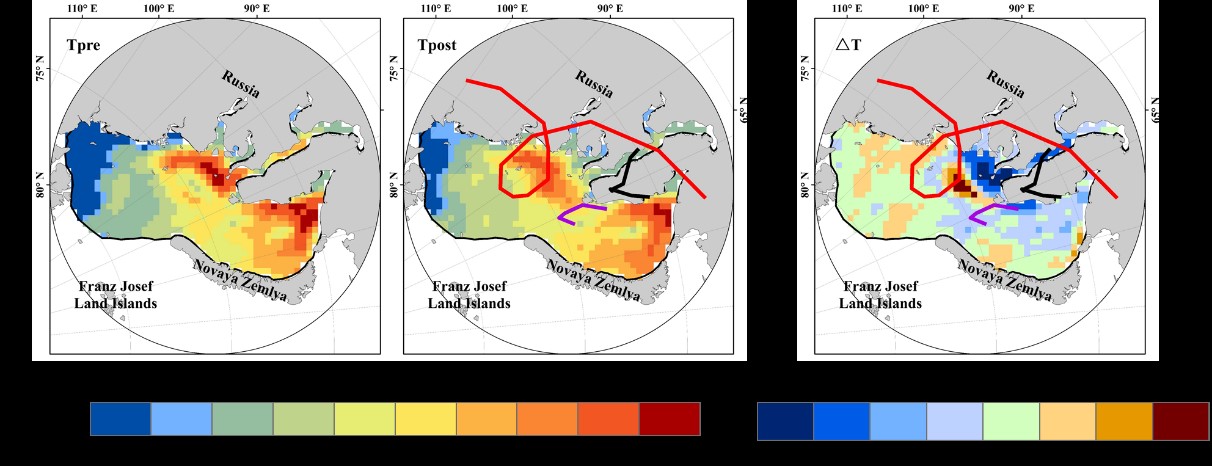
In recent years, the intensity of Arctic cyclones has remarkably increased and the impact on the Arctic ecosystem has become more prominent. The Kara Sea is a Russian marginal sea with wide shelf, high productivity of phytoplankton, and abundant resources, and has a very important strategic position and research significance. We have used multiple datasets, including satellite remote sensing data and model reanalysis, to obtain the spatial-temporal distribution of Chlorophyll-a (Chl-a) concentration and sea surface temperature (SST) before and after the passage of the Arctic cyclone over the Kara Sea in summer, to explore basic processes and the ecosystem response to the cyclone. The results indicated that after the passage of the Arctic cyclone, the Chl-a concentration in different regions of the Kara Sea increased at different levels, and the SST decreased briefly. The increase of Chl-a concentration (0.49 mg/m3) caused by the Arctic cyclone happened in Kara Sea in July 2012. The nearshore Chl-a concentration increased more than that on the continental shelf, the continental shelf increases in turn being greater than the deep sea; however, the nearshore response time was shorter than that on the shelf and the deep sea. Compared with nearshore SST, which decreased more than 2 °C, the SST on the continental shelf and in the deep-sea area decreased slightly less. Besides, the left side of the cyclone cooled faster than the right side.
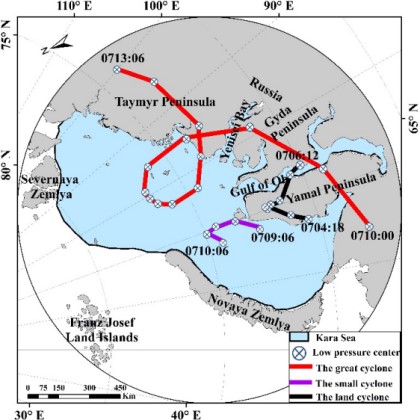
Fig. 1. The Arctic cyclones of July 2012 in the Kara Sea (The label format is mmdd:hh. mm means the month when cyclone occurred; dd means the day; hh means hour).
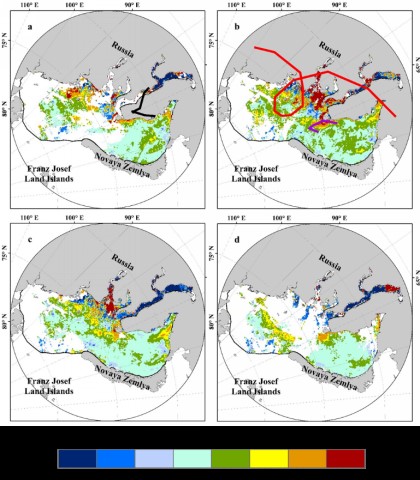
Fig.2. Variation of Chl-a concentration due to the passage of Arctic cyclones (a) Difference between land cyclone and before the cyclone; (b) Difference between great cyclone and before the cyclone; (c) Difference between week 1 post-cyclone and before the cyclone; (d) Difference between week 2 post-cyclone and before the cyclone.