Satellite-Based Estimation of Particulate Organic Carbon Export in the Northern South China Sea
Date of Issue:2022-04-12
Reading:1271
Li, T., Y. Bai, X. He, Y. Xie, X. Chen, F. Gong and D. Pan. Satellite-Based Estimation of Particulate Organic Carbon Export in the Northern South China Sea. Journal of Geophysical Research: Oceans, https://doi.org/10.1029/2018JC014201..
Knowledge of particulate organic carbon export flux (EP) is the key to understanding the marine biological carbon pump. In this study, a satellite remote sensing algorithm based on the food-web model established by Siegel et al. (2014) was used to estimate EP in the northern South China Sea (NSCS), which consists of direct sinking flux of large phytoplankton and associated aggregates by gravity and flux of zooplankton feces by grazing. This is the first time that fine spatiotemporal variation of satellite-derived EP in the NSCS is unveiled. Compared with the results on 1° spatial scale products, the model results based on the satellite products with 1/3° and 1/12° resolutions showed better consistency with the observations. Validation with in situ EP showed that the model exhibited a good performance in the NSCS basin, but the predicted EP in the shelf regions were smaller compared with measurements. The satellite-derived annual-mean EP in the shelf areas was 8.47 and 5.56 mmol C·m-2·d-1 in the NSCS basin, on the 1/3° spatial scale, with relative differences from observations were about -50% and -15% for the shelf and basin, respectively. The flux of feces from zooplankton grazing, especially that from microzooplankton grazing, might account for the major fraction of the EP in the NSCS. Accurate products of ocean net primary production and empirical coefficients in the food web (e.g., export efficiency of zooplankton grazing and specific mortality rate of nongrazing phytoplankton) suitable for the NSCS, are essential for performance improvement of the satellite-based EP model.
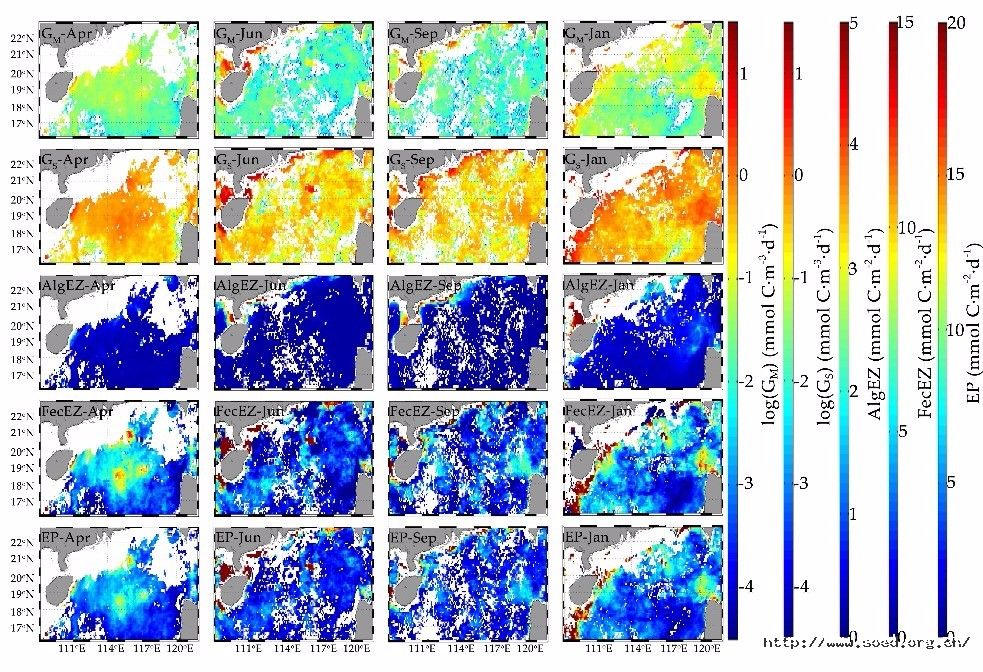
Figure 1. Spatiotemporal distributions of model input parameters. OPP, P, Zeu, Zml, and FM are the ocean net primary production, phytoplankton carbon content, euphotic layer depth, mixed layer depth, and fraction of microphytoplankton with size 20–50 μm, respectively. April 2010, June 2009, September 2010, and January 2010 are used to represent spring, summer, autumn, and winter seasons, respectively. Abnormally high Zml values in the coastal areas were removed before the analysis.


