Understanding the effect of an excessive cold tongue bias on projecting the tropical Pacific SST warming pattern
Date of Issue:2022-04-12
Reading:1277
Ying J., Huang P., Lian T., Tan H. (2018). Understanding the effect of an excessive cold tongue bias on projecting the tropical Pacific SST warming pattern in CMIP5 models. Climate Dynamics, http://doi.org/ 10.1007/s00382-018-4219-y
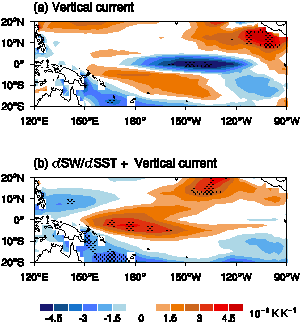
An excessive cold tongue is a common bias among current climate models, and considered an important source of bias in projections of tropical Pacific climate change under global warming. Specifically, the excessive cold tongue bias is closely related to the tropical Pacific SST warming (TPSW) pattern. In this study, we reveal that two processes are the critical mechanisms by which the excessive cold tongue bias influences the projection of the TPSW pattern, based on 32 models from phase 5 of Coupled Model Intercomparison Projection (CMIP5). On the one hand, by assuming that the shortwave (SW) radiation to SST feedback is linearly correlated to the cold tongue SST, the excessive cold tongue bias can induce an overly weak negative SW–SST feedback in the central Pacific, which can lead to a positive SST warming bias in the central to western Pacific (around 150°E–140°W). Moreover, the overly weak local atmospheric dynamics response to SST is a key process of the overly weak SW–SST feedback, compared with the cloud response to atmospheric dynamics and the SW radiation response to cloud. On the other hand, the overly strong ocean zonal overturning circulation associated with the excessive cold tongue bias results in an overestimation of the ocean dynamical thermostat effect, with enhanced ocean stratification under global warming, leading to a negative SST warming bias in the central and eastern Pacific (around 170°W–120°W). These two processes jointly form a positive SST warming bias in the western Pacific, contributing to a La Niña-like warming bias. Therefore, we suggest a more realistic climatological cold tongue SST is needed for a more reliable projection of the TPSW pattern.